Tuesday, March 29, 2022

Post Production

 Post Production

While analyzing out first attempt, we realized that we didn't really convey the meaning of the genre and we tried to fit the whole story in the production causing it to look rushed. Our teacher gave us feedback on how to make it better, when we did wrong, and unnecessary parts. We cut out dialogue because it was unnecessary to our production because it was supposed to be a dream sequence and there isn't any dialogue in one. When editing our film, we mostly used straight cuts because that is they type of transition that is frequently in horror movies. We utilized straight cuts to show shots of our school to establish the location. We used a shot-reverse-shot to give the impression that there was dialogue happening. Dissolves were used to symbolize a passage of time.


Technology:

Throughout this film, we used technology that was easy for us to get our hands on: an iPhone 12 and an iPhone 11. We had to switch back and fourth between the two phones due to the 12 having storage problems and the phone just cutting out in a spot of our shooting site. We used the 11 for some shots since it didn't cut out and it had ample storage. We had the camera setting at 4K at first but before re-shooting, our teacher suggested to not have the quality as sharp as it was so we dialed it down in settings. 

Before we filmed the second time, we ran into the issue of the branding on our clothing. Before we decided to re-shoot, Nia tried to photoshop the branding so we could avoid copy right but it would have taken too long because it would go frame by frame. Plus, we needed to re-shoot anyways. For our editing software, we used WeVideo.com. The website was easy to navigate, we edited our video how we deemed fit ten exported it to our class YouTube account. 


Editing: 

When we uploaded our videos into WeVideo, we placed them in the order they needed to go in, add the black and white filter since we couldn't change lighting so we used it for dark tones. We used fading transitions to emphasize that it was a dream. For sound, we used chilling music with suspense then ha d it progress to a fast pace when the killer came on screen and chased me. The other sound like knocking and the panting were made by us. The gasp and panting was used to show a sense of fear and uneasiness about the dream.

Saturday, March 5, 2022

Branding

 Branding


The Branding Process

When we were tasked to come up with a name for our production company, we started bouncing ideas off each other. Evicka came up with the name "JEN-Z" and we all surprisingly liked it. The names stems from 2 thing: all if us are in Generation Z and our names conveniently make out the name. The J is for Ja'Niyah, the E is for Evicka, the N is for Nia, and the Z is for Zhanae (me).  After that. we looked for names to but at the end like companies do. We looked at: pictures, studios, productions, films, and entertainment. We decided that productions would be the best fit and that was JEN-Z Productions came to be. Afterwords, we made our own production company videos. Below I have inserted mine.


Thursday, March 3, 2022

Production

 Production


Filming Process

When the pre-production stage was completed, we started filming our shots as soon as we could. The plan was to film from February 22-25 but we (the class) were all catching up on blogs, trying out the editing software, making our branding for our opening sequence, and making changes to things that our teacher deemed necessary. Due to this, the teacher gave us an additional week to film, February 28-March 4. Within this week, we started to film the shots in the library and in the halls. We used Nia's iPhone 12 and Evicka's iPhone 11. On Monday, we shot me walking in the hall; it was also picture day for us. On Tuesday and Wednesday, we did shots with just me, Nia, and Evicka since Ja'Niyah was absent. On Friday, Ja'Niyah came and we did the shots that had her. Using a phone and adjusting the camera settings made a really good camera instead of using actual ones. Using the right angles and camera movements portray the meaning through the video. In one the scenes where Ethan (a classmate), for example, we used a low angle shot to make him appear larger and menacing since he isn't that tall. There weren't any tutorials used since the equipment/camera was our typical, everyday phone. Me and my group-mates launched ideas of how we could shoot the scene.

Bloopers/ "A-ha" Moments

This is a clip of me walking in the hall but the setting was in time-lapse, making it look funny and sped up, My friend who aren't n CTA happened to be in the halls and tried to talk to me but I had to get the shot,


In this shot, I was coming in to tell them my line but it was too funny because it was the first time i said it and me, Nia, and Evicka busted out laughing.


In this shot, I had to record my classmate Ethan running in the halls but the thing is, I was running backwards and I got scared because I thought i was going to hit something so I just started yelling okay over and over. 

Thursday, February 10, 2022

Preproduction

 Preproduction


For my film portfolio, me and my group-mates (Nia, Evicka, and Ja'Niyah) are producing a movie intro for a horror/thriller movie while following the conventions of the genre. Before we all began the project, our groups were picked by us by doing interviews on our classmates. We came to the conclusion of our groups based on the questions asked.  A few days later, our teacher gave everyone a group contract that had to be signed by the person it was given to, out parent/guardian, and our teacher then given back to the teacher. After this, we were given the assignment of making a short story based around our intro (we basically gave it a middle and end). After that was turned in, we researched different movies and analyzed their intros to get an understanding of what these films are expected to have. Following this, we made our script and storyboard.


Storyboard

In the story board process, we made a Word document with a shot by shot analysis chart. We split the chart up into categories, each taking one, then came as a group to decide on the description. After we did this, we went into StudioBinder and placed the information in the storyboard feature.


Description of Storyboard


Mise-en-Scene

For this film opening in the horror genre, we dwelled on locations but decided on areas around the school. We chose the library and the main floor hallway. Props we will use will be things like books, textbooks, pencils, papers and things like that. Since filming will take place during school hours, costuming will consist of our CTA uniform with little to no makeup. We will utilize the lighting that is already there in our various locations. 


Cinematography

The cinematography plays a big role in our film. We have from February 22nd to March 4th get our shots and scene. We need to take into consideration on how much shots we need to get for our scenes within the time provided. When filming, we will use our phones and we will use tripods if necessary. Medium shots, long shots, establishing shots, close ups, low angle shots, and tracking will be used.


Sound

Sound creates mood/feeling for films, bringing it together with the other components. For the sound portion, we will use dialogue between actors, conversations, that will get picked up by the phone being recorded with, an unsettling music score, utilizing silence, and using a voice over of someone talking.

Saturday, February 5, 2022

Case Study

 INSIDIOUS


History/ Target audience
 Director James Wan portrayed in this film a family trying to prevent evil spirits from trapping their comatose son in the realm called The Further for the audience of teens and adults, PG-13. It is based off ideas from James Wan and Leigh Whannell.

Production
This film was produced by Jason Blum, Steven Schneider, and Oren Peli. Blumhouse Productions, the production company, is mainly known for producing horror films such as this one. Insidious(2010) had the budget of $1.5 million, a large enough budget for filming to be done in 3 weeks. 

Distribution
Insidious was distributed by FilmDistrict in the United States and Sony Pictures Releasing International, internationally. The movie was released theatrically on April 1, 2011 after the announcement made for it's release on December 29, 2010 due to Sony Pictures Worldwide Acquisitions picked up the U.S distribution rights to the film and worldwide distribution rights to the film after it's world premier at the Toronto International Film Festival on September 14, 2010. Besides being in theaters, Insidious was released on Blue-ray.

Marketing
For the advertisement of Insidious, the first promotional clip was released on September 14, 2010. During the following December, M Global (production company) released an image and sales poster. Then On December 22, 2001, FilmDistrict released the film's first teaser trailer. No more than a month later, the theatrical trailer was made available online via Blastr. 

Cross-media convergence and synergy
The film has an introduction where the audience gets a flashback indicating that there was a series of events that happened for the movie to take place. The flashback doesn't leave the audience questioning what caused the chain of events to take place.

Thursday, February 3, 2022

Script Writing

 Script Writing

The genre horror is a movie genre that if scary and terrifying for the purpose to entertain. The target audience for films in the genre would be younger people, teens and young adults, because this audience likes to seek thrill. The purpose of horror movies are to show viewers a world that's is not ordinary compared to theirs's.

Based on my research pertaining to script writing/screenplay for horror, I have found that horror's screenplay is different from the other genres. Films in horror must have particular aspects in order to stay on track with the conventions of a horror motion picture such as scaring, showing gross and gory things, and/or expected but unexpected scenes to get the target audience's heart racing and body full of adrenaline. 

Key things that script writers include in screenplays:

The balance of more action than dialogue: show instead of telling the audience what characters fear the most
Gore: Gruesome death and/or torture scenes with detail to unsettle the audience more
Jump scares: Loud sudden noises or unexpected images to make viewers jump (out of their skin)
A villain or monster: Anyone, or anything for that matter, that is beyond control. The audience needs to know what makes the bad guy tick and what they are capable to achieve
Mounting suspense: Pacing the story and action to surprise the viewers

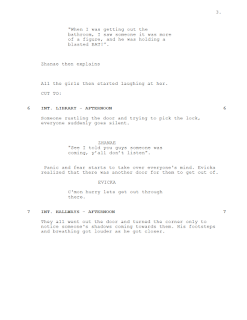
The images inserted above are my script for my portfolio.

~~~~~~~~~~~~~~~~~~~~~~~~~~~~~~~~~~~~~~~~~~~~~~~~~~~~~~~~~~~~~~~~~~~~~~~~~~~~~

Wednesday, February 2, 2022

Production, Distribution, and Exhibition

 Production, Distribution, 

and Exhibition


Production

  • For a film to being production, it is important for investors to provide the necessary funding. The box office success is never guaranteed so investors try to reduce the risk of  losing their money by being involved in important decisions. 
  • Questions will be asked by investors such as does it offer easy selling points, is the film's story line similar to other films that have made money recently, and are there any obvious marketing spin offs to give added publicity and a few others.
  • A film has to be "green-lit" before a director can start filming. The term "green-lit" means that the funding has been made available by the investor. At this stage, a project will have the key elements of a project: principle cast, director, cinematography, screenplay. It's the director's job to bring all of these elements together.

Distribution

  • At the start to plan a marketing campaign, the film distributor will have to decide how it will present a film to a potential audience. The distributor needs to decide what differentiates this film apart from others that are released. They look for something called a USP - unique selling point. 
  • For example, if the distributor is managing an action film, they would need to look for components of the film that sets it aside from other films in the genre.


Exhibition

  • The release of a film marks the final stage of part one of a film's journey from idea to audience, After the theater release, the film will then be accessible by several different formats.  Each of the "exhibitions" offer the opportunity of profit generation.

Friday, January 28, 2022

Research on Horror films

 Research on Horror Films


For my portfolio project, I will be doing a film opening with a horror/thriller genre. I was assigned to make a comparison chart with my group mates about other films in the genre. I was then asked to research my genre.


Some visual components for some horror movies would be underexposure, mirrors and reflections, tight framing, and subliminal imagery. Exposure over all is important because it can set the mood. Underexposure accentuates shadows, captures a mysterious scene, gives an overwhelming sense of dread, and many more other things. It's one of the ways a filmmaker can use to play with the audience's sense of what is caught in the frame, it can hide things from you that the directors don't want you to see until the appropriate time. Mirrors and reflections are used in connotations with superior techniques by illustrating both reality and the duality of the characters. A way to survive in a horror movie is to not look in the mirror because as stated previously, there is a connotative purpose behind mirrors and things that reflect in movies such a horror. They are a tool used to illuminate and visualize depth. But in this genre, they are utilized as a tension builder, drawing into a good jump scare, or by subverting this all too familiar tactic. Tight framing is used to draw attention to one specific idea. Tight framing can also be used to entice the audience to a variety if concepts around the protagonist. Subliminal imagery is to make you feel something you aren't used to. These subliminal images are meant to get a feel for the audience is a sense and to makes those who end up seeing them viscerally ill.


Horror films usually take place in cabins, dorms, amusement parks, forests, cemeteries, and abandoned/old buildings. Of course there are occasionally other settings but these few are the most frequent. 9 times out of 10, they are shot at night. 


The usual target for the films of this genre are teens to adults within the ages 15-24. These films often attract a slightly younger audience. They tend to intertwine with thrillers in a way that viewers seek out by diving into a world that isn't their own. Making a film based on what has high views and get good ratings would draw attention to your movie when creating a film for your target audience. 


Fonts for this genre may range from something simple and elegant to bold and dramatic. The size is moderately large. They commonly come in colors such as red, white, off white, and yellow. Sometimes the letters gave blood spatter. The letters are almost always uppercase.


There are different types of stereotypes in horror. The dumb blonde, the bad boy/girl, the non-believer, the scholar, the cop, and the killer. There is occasionally black people who die first, if there is no black person, it's usually the dumb blonde.


Sources

Wednesday, November 17, 2021

Editing Review

Editing Software Review


I have selected 3 editing software to review. the 3 software's I chose were clipchamp.com, openshot.org, and vimeo.com.  I am evaluating these websites with a criteria to follow.

Comparisons and Contrasts

Requirements:

Accessible from anywhere(web based):  Clipchamp.com, Vimeo.com
Ability to multiply tacks (both audio and video): Clipchamp.com, Openshot.com
Ability to strip or mute audio and natural sounds from video: Clipchamp.com, Vimeo.com, Openshot.com
Ability to collaborate with other users: Clipchamp.com, Vimeo.com

Evaluation:

The software app I am going to use in the future is Clipchamp.com. I would use clipchamp because it fits all the requirements. The website is also very easy to use and I can access it from anywhere. I can collaborate with my classmate without having to worry about it not getting done right because I can simply fix it myself.

Friday, October 29, 2021

Research on Film Openings

Research on Film Openings

  •  The key elements/features of film openings are establishing setting, mise-en-scene, character placement, representing genre, and cinematography. Establishing setting means to give the audience an insight on where the film is set and to draw them in. Establishing setting may sometimes give indications into the plot and the narrative in which the story is told. The setting could be determined with an establishing shot which can provide the audience context about the character along with more details about the film. Mise-en-scene is a French term that translates to "place on stage". This is very important because everything that is in frame for a scene is there for a reason and is used from representing emotion and setting the mood of the scene and/or film. From the audience's outlook, we get a genuine sense and feel for the film. The things caught in the frame, such as costumes and props, can tell what time period the film takes place or the beginning of things that are about to take place. Mise-en-scene is one of the most important factors of the film that tempt us to watch the films. Character placement is important because it helps in the development of the scene. The distance between two characters can help establish their relationship to one another. Do they stand shoulder to shoulder or do they stand on opposite sides of the room from each other? The placement can tell a lot about the characters without them even having to converse. Representing genre is simple but the execution can be complicated. You have to establish the genre in a way that won't reveal too much in the opening scene so the audience know what they are about to watch. With the use of genre conventions, there will be suggestions of the narrative and story line and get a perception of what will come further along in the film. As an audience, we decide what type of movie we want to watch, so if the opening isn't giving us what we need, we won't be interested in it anymore as as much as before. Cinematography is the way you present footage, it's just as important as the content. The visual appearance is important when creating the opening scene. When the opening is aesthetically pleasing, we as an audience will become influenced into the film due to the fact that it meets our needs. 

  • The purpose and reasoning for film openings are to convey a powerful expression of motion graphics that serve the purpose to prelude to the movie. Opening sequences engage they audience by dropping hints about what is about to start whether it be a movie, TV show, or an animation. A primary function of a title sequence is to set the tone of what you are about to watch. The effectiveness of title sequences are engaging and exciting the audience by indicating some of the topics, themes, and in some cases, the challenges the characters may possibly be facing. The manifest is to build anticipation, suspense, while sometimes revealing some of the traits the main character has and potentially setting the stage with questions that will be answered later on in the plot and movie. 
  • The similarities in the opening sequences (conventions) irrespective of the genre.

Compare/Contrast conventions by genre

Visual Elements: A common setting in horror, drama, and comedy films are haunted/abandoned house. Horror movies use low-key and dim lighting, dramas use side lighting. Dramas, comedies, and horror use medium shots, close up shots, establishing shots, and long shots in their opening scenes. 

Character development: Character times common in both horrors and dramas are the protagonist and the antagonist.

Plot Introduction: Plots for horror and dramas movies are typically introduced by flashbacks and flash forwards while comedies are opened by teasers. 

Representation: In both drama and horror, there are evident stereotypes that are sometimes displayed in the opening scene of these films.

3 Favorite Film Openings

3 Favorite Film Openings


Matilda

Summary

Matilda Wormwood is a gifted girl with crude and distant parents. Matilda loves to read and always wanted to go to school. Her father, Harry Wormwood, sells a car to a powerhouse woman, Agatha Trunchbull, who happens to be the principal of a school near by. They make some sort of deal. Harry informs the young girl that she is starting school soon and is ecstatic about it. Do to Matlida reading at the library so frequently before she started school, she knows a lot for her age. On her adventures, Matilda discovers she has telekinetic powers and puts them to good use. She scares away the principal. Ms. Honey Matilda's teacher, walks her home where they find out the Wormwoods are moving to Guam. Matilda takes adoption papers out her school bag so Ms.Honey could be her mother. Her mother and father, Harry and Zinina, sign and get in the car with their son Micheal and drive off. Matilda and her new mother live happily together.


Time stamp

7:16


Summary for opening to plot

The opening shows how from such a young age that Matilda can hold her own and take care of herself without the help of her parents or older brother. It also shows that as Matilda gets older, her love for books never faded.


Purpose

The purpose of this movie opening was to show how Matilda's parents never liked her since she wars born. It then travels to how Matilda would take care of herself. And it would also show how Matilda grew up loving books.


The Sound of Music

Summary

Maria is a postulant at an Austrian abbey who then becomes the governess for a widowed naval captain who has seven children. Maria and the von Trapp children form a bond, the governess teaches them how to sing, the von Trapp children's father, Captain von Trapp plans to marry Baroness Elsa Schraeder. The children do not wish have the baroness as their step mother. Maria realizes that she has feelings for the captain and the baroness notices quickly and scares away the governess back to the abbey. The captain finally realizes his love for the Fraulein but it was too late. The children go to the abbey but Maria has been locked into her room for days and not talking to anyone. With the help of the Reverend Mother, Maria decides to go back to the von Trapps. She goes back and marries the captain. The Nazis force Georg (Captain von Trapp) to join their naval service but he doesn't agree. He and the family prepare to run away to avoid this. They get caught and lie saying that they were trying to preform at the Salzburg Festival. After they preform, they sneak out and run to the abbey once they find out that the Nazis are searching for them. They hide out in the abbey and escape into the mountains where the coast is clear.


Time Stamp

5:00


Summary for opening to plot

The opening shows how Maria loves to sing and in the movie, she teaches the children how to sing and the family gains something off of it.


Purpose

The purpose of this movie opening was to show Maria's love for singing and to give an idea of the setting for the movie. It then ties into how Maria is late and always forgetful and gets in trouble at the abbey.


Five Feet Apart

A 17 year old girl spent majority of her life in the hospital due to cystic fibrosis. In her time at the hospital, she meets this boy who also has the condition. They fall in love through strict restrictions and keep the required distance from each other.


Time stamp

0:34-1:33


Summary for opening to plot

In the opening scene, we see clips of numerous people living the lives they do and voice over from Stella discussing the importance of human touch. She talks about how you don't realize how important touch is until you can't have it. It connects to the plot because in the opening because the voice over she says that two people with cystic fibrosis can't come in close contact with each other. 


Purpose

The purpose of this film opening is to give the viewer an insight on Stella's life.


Comparison/contrast of the films

Visual elements

In Matilda, The Sound of Music, and Five Feet Apart the cinematography used in the films are long shots, medium shots, close up shots, and extreme long shots. The Sound of Music and Matilda use a lot of natural light, panning, cutting on action, occasional low key lighting and a lot of scenes are outside. Five Feet Apart also uses high key lighting but more frequently and the setting is a hospital.


Auditory elements

Five Feet Apart and Matilda uses voice overs and dialogue but the dialogue in Matilda is from a person who isn't named in the film while in Five Feet Apart, Stella does the voice overs. The Sound of Music uses dialogue but no voice overs but instead has background noises like birds chirping, rain falling, the echo of the house, and the slamming of things. 


Character

In Matilda, character of importance are: Matilda, her parents, her teacher, and the principal. But in the Sound of Music and Five Feet Apart, there are many characters introduced and they all have significance in the stories but the characters with the most importance are Stella and her lover.


Representation

In Five Feet Apart, the sickness puts limits on thing Stella can do. But in Matilda, her powers allow her to do things you can only imagine.

Final Production

  Final Production This is our final production "Insider or Intruder".